Intelligent Solar SEPIC Charger with Adaptive MPPT and Battery Management in Simulink
Study an intelligent solar battery charger in which adaptive MPPT supplies a PV operating-point reference to a SEPIC power stage while battery-side control enforces charging limits.
Open the MP4 simulation output · Enquire about the model and research support
Research objective
Coordinate energy harvesting and safe charging during changing irradiance without allowing the converter to violate battery voltage or current constraints.
Software, platform and engineering domain
Primary platform: MATLAB/Simulink & Simscape Electrical. Research domain: Solar Power Electronics and Battery Engineering. The video title identifies the intended workflow; the video and original model must be inspected before making quantitative claims.
Model architecture and simulation methodology
- Model the PV source with irradiance/temperature dependence and resolve the SEPIC inductor, capacitor, diode and switching paths.
- Generate an adaptive MPPT duty or voltage reference with saturations and a defined sample period.
- Implement battery charging supervision with current, voltage, SOC and temperature limits appropriate to the chosen equivalent battery model.
- Test transitions between MPPT-priority operation and battery-limited operation while recording energy balance.
What the video outputs should demonstrate
- PV voltage/current/power and available maximum-power reference
- SEPIC duty cycle, inductor ripple and intermediate capacitor stress
- Battery charge current, terminal voltage, SOC and charging mode
- Harvested energy, converter efficiency and charge-current overshoot
Interpreting the simulation results
Optimal harvesting and safe charging are sometimes competing control objectives. Report periods where the battery constraints intentionally curtail PV power instead of counting them as MPPT failures.
- Separate maximum-power tracking from charge-current regulation when limits conflict.
- Check SEPIC component ripple and discontinuous-mode entry at low irradiance.
- Do not infer battery SOH improvements without an aging model.
Suggested research comparisons
- Baseline 1: fixed-duty SEPIC charger
- Baseline 2: P&O-controlled SEPIC without battery limits
- Baseline 3: adaptive-MPPT SEPIC with charge supervision
Use the same physical parameters, boundary conditions and plotting window when comparing alternative methods. Numerical improvement cannot be established from the title alone.
Project screenshot and thumbnail
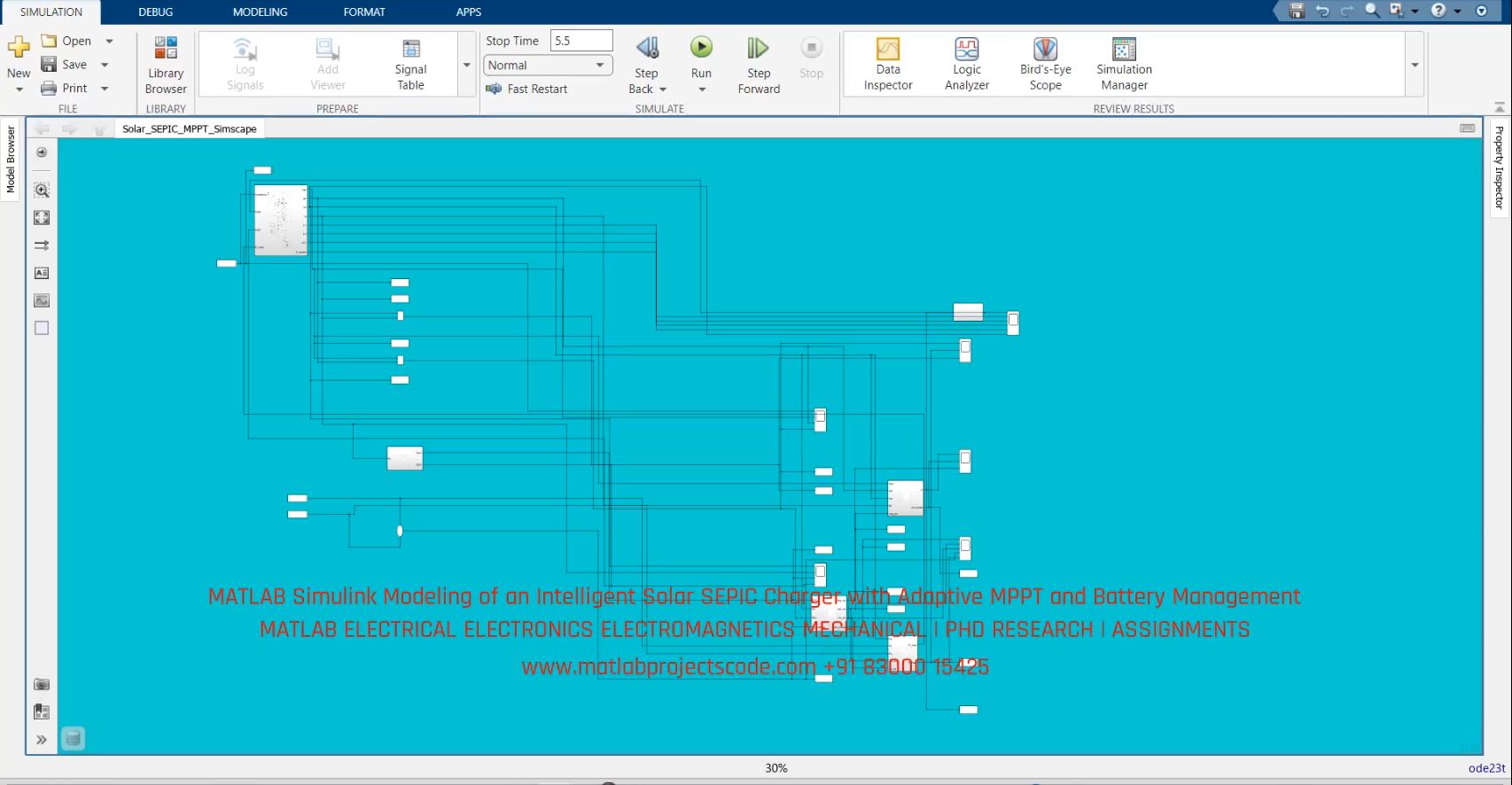
Image availability and extension must be verified on hosting before Google video indexing is assessed.
Research questions and frequently asked questions
Which software is used?
The project is associated with MATLAB/Simulink & Simscape Electrical; verify the model and solver version with the original video and source files.
Which results should be checked?
Key checks include pv voltage/current/power and available maximum-power reference, sepic duty cycle, inductor ripple and intermediate capacitor stress.
Can the video alone validate the results?
No. Model assumptions, boundary conditions and actual output traces must be reviewed before treating any simulation as validated research.
OEM and PhD research enquiries
For research model implementation, simulation verification, paper reproduction and engineering documentation across UK, Australia, Canada, US and global teams, use the contact page. Contents are for representative purposes; actual content may vary.