High-Efficiency Solar Energy Harvesting Boost Converter with Adaptive MPPT in Simscape
Investigate a photovoltaic boost-converter energy harvester with adaptive maximum-power-point tracking, focusing on startup behaviour, light-load losses and useful delivered energy.
Open the MP4 simulation output · Enquire about the model and research support
Research objective
Test whether adaptive tracking delivers greater net energy than simpler MPPT methods once converter conduction, switching, control and startup losses are included.
Software, platform and engineering domain
Primary platform: MATLAB/Simulink & Simscape Electrical. Research domain: Ultra-Low-Power Energy Harvesting Engineering. The video title identifies the intended workflow; the video and original model must be inspected before making quantitative claims.
Model architecture and simulation methodology
- Define the PV cell/array I–V characteristics at low and varying irradiance with realistic source resistance.
- Model the boost inductor, switch, diode or synchronous rectifier, output capacitor and load or storage interface.
- Implement adaptive MPPT with sampling, duty constraints and startup/undervoltage safeguards.
- Measure both extracted PV power and net output energy so controller overhead and conversion losses are visible.
What the video outputs should demonstrate
- PV V/I/P tracking and MPP reference across illumination changes
- Inductor current, output voltage and startup-to-regulation time
- Input/output energy, measured efficiency and quiescent/control power
- Tracking oscillation, missed-peak energy and low-light operation threshold
Interpreting the simulation results
High MPPT tracking efficiency can coexist with poor net harvested energy if control and converter overhead dominate at low light. Compare energy delivered to storage over a full illumination profile.
- Include controller consumption when claiming ultra-low-power energy-harvesting efficiency.
- Validate converter mode transitions and avoid incorrect ideal-diode assumptions.
- Do not extrapolate peak efficiency at one load to all light levels.
Suggested research comparisons
- Baseline 1: fixed duty boost harvester
- Baseline 2: conventional perturb-and-observe MPPT
- Baseline 3: adaptive MPPT with net-loss modelling
Use the same physical parameters, boundary conditions and plotting window when comparing alternative methods. Numerical improvement cannot be established from the title alone.
Project screenshot and thumbnail
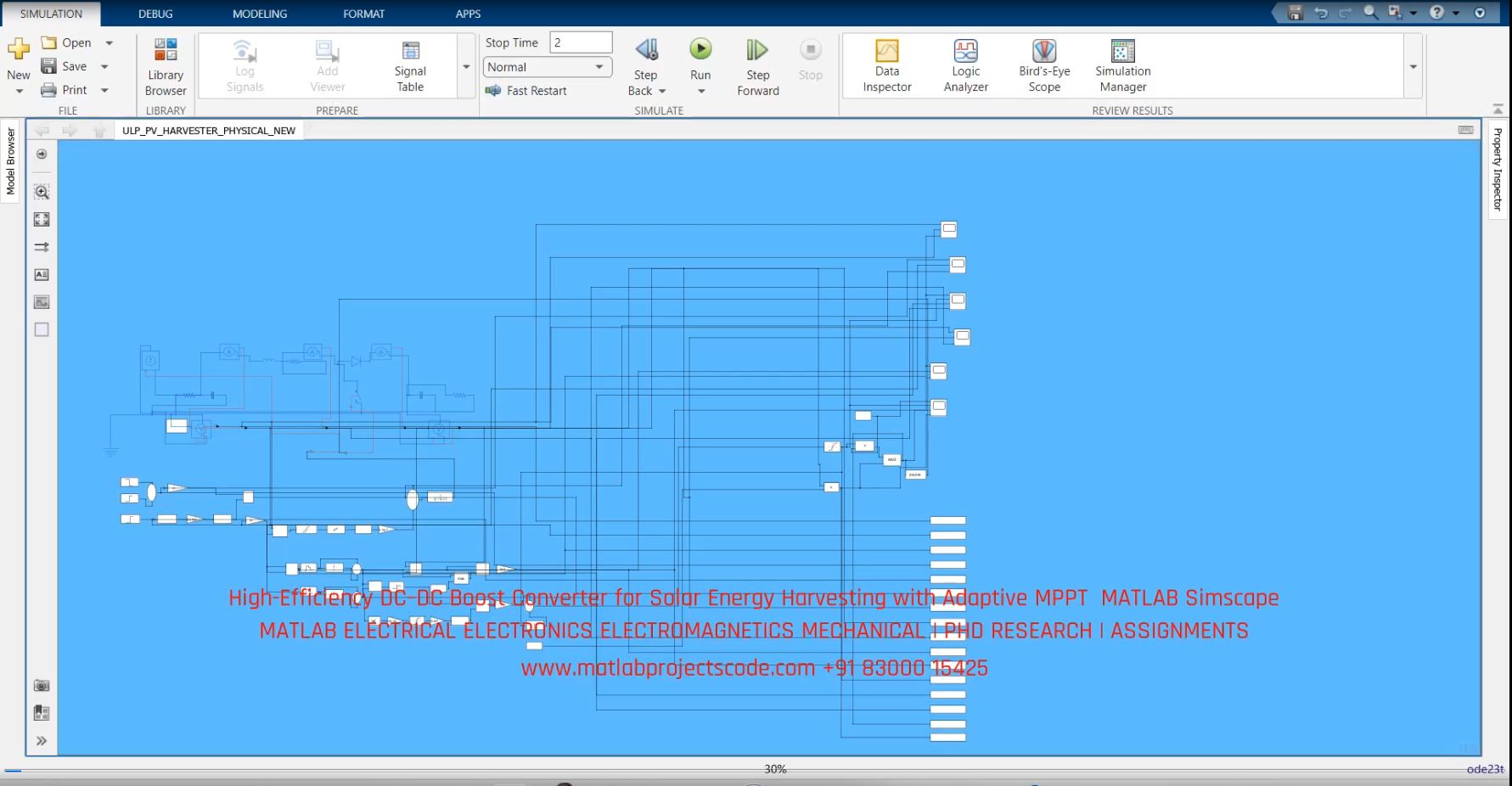
Image availability and extension must be verified on hosting before Google video indexing is assessed.
Research questions and frequently asked questions
Which software is used?
The project is associated with MATLAB/Simulink & Simscape Electrical; verify the model and solver version with the original video and source files.
Which results should be checked?
Key checks include pv v/i/p tracking and mpp reference across illumination changes, inductor current, output voltage and startup-to-regulation time.
Can the video alone validate the results?
No. Model assumptions, boundary conditions and actual output traces must be reviewed before treating any simulation as validated research.
OEM and PhD research enquiries
For research model implementation, simulation verification, paper reproduction and engineering documentation across UK, Australia, Canada, US and global teams, use the contact page. Contents are for representative purposes; actual content may vary.