3D PEM Water Electrolyzer Simulation in COMSOL 6.4 for Hydrogen Production
Review a three-dimensional PEM water electrolyzer model in COMSOL Multiphysics 6.4, focusing on electrochemical operation, membrane transport and hydrogen production with explicit engineering assumptions.
Open the MP4 simulation output · Enquire about the model and research support
Research objective
Connect a modelled current-density distribution and species/charge transport to a reproducible hydrogen-production calculation.
Software, platform and engineering domain
Primary platform: COMSOL Multiphysics 6.4. Research domain: Hydrogen and Electrochemical Engineering. The video title identifies the intended workflow; the video and original model must be inspected before making quantitative claims.
Model architecture and simulation methodology
- Specify cell layers and separator geometry with membrane, electrode and porous transport properties.
- Couple electrochemical reactions to charge conservation, current collectors and species transport according to the implemented physics.
- Set realistic boundary conditions for feed-water supply, temperature and electrical excitation.
- Calculate hydrogen molar production from integrated cathode current and clearly defined Faradaic efficiency.
What the video outputs should demonstrate
- Hydrogen molar flow rate and mass production per current input
- Area-specific current density and cell-voltage relationship
- Membrane ohmic loss and local reactant concentration gradients
- Predicted energy consumption per unit hydrogen with stated efficiency basis
Interpreting the simulation results
Hydrogen flow predictions derived from Faraday’s law must remain consistent with cell current. Reporting performance requires distinguishing thermodynamic efficiency, voltage efficiency and assumptions about balance-of-plant power.
- Confirm stoichiometric scaling and unit conversion from amperes to mol/s.
- Check whether gas bubbles and two-phase flow are actually included.
- Separate nominal operation from degradation/corrosion scenarios unless those physics are implemented.
Suggested research comparisons
- Baseline 1: ideal Faradaic conversion
- Baseline 2: transport-aware COMSOL cell
- Baseline 3: temperature/conductivity sensitivity
Use the same physical parameters, boundary conditions and plotting window when comparing alternative methods. Numerical improvement cannot be established from the title alone.
Project screenshot and thumbnail
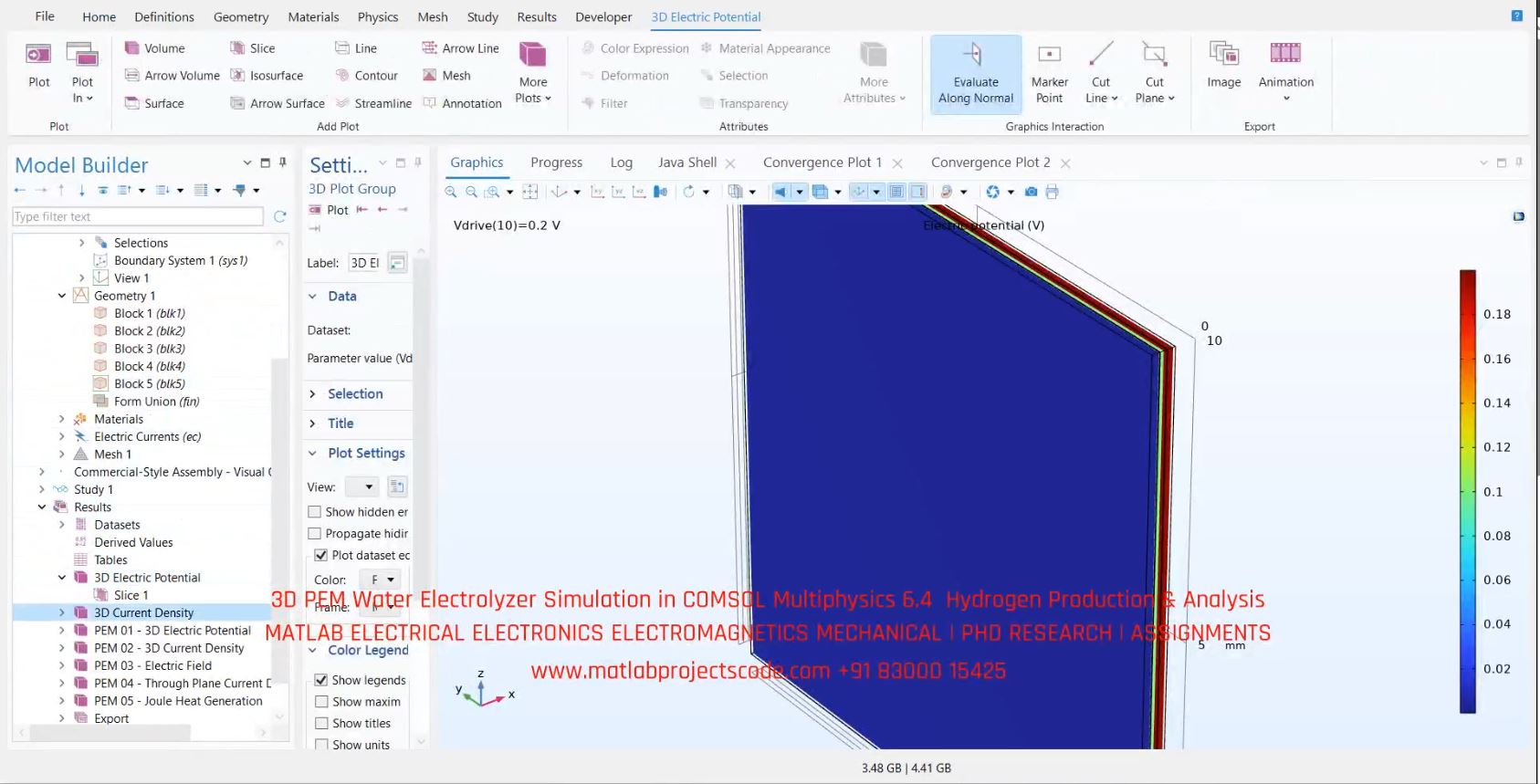
Image availability and extension must be verified on hosting before Google video indexing is assessed.
Research questions and frequently asked questions
Which software is used?
The project is associated with COMSOL Multiphysics 6.4; verify the model and solver version with the original video and source files.
Which results should be checked?
Key checks include hydrogen molar flow rate and mass production per current input, area-specific current density and cell-voltage relationship.
Can the video alone validate the results?
No. Model assumptions, boundary conditions and actual output traces must be reviewed before treating any simulation as validated research.
OEM and PhD research enquiries
For research model implementation, simulation verification, paper reproduction and engineering documentation across UK, Australia, Canada, US and global teams, use the contact page. Contents are for representative purposes; actual content may vary.