COMSOL Liquid-Cooled 18650 Battery Pack Thermal Analysis at 3C Discharge
Explore the transient thermal response of a liquid-cooled 18650 battery module at a 3C discharge rate, including cell-to-cell temperature differences and cooling-channel heat extraction.
Open the MP4 simulation output · Enquire about the model and research support
Research objective
Evaluate whether a proposed coolant geometry and flow boundary condition control maximum cell temperature and spatial nonuniformity under high-rate loading.
Software, platform and engineering domain
Primary platform: COMSOL Multiphysics. Research domain: Mechanical and Thermal Engineering. The video title identifies the intended workflow; the video and original model must be inspected before making quantitative claims.
Model architecture and simulation methodology
- Construct cylindrical-cell geometry, relevant contact interfaces, cooling plates or coolant channels, and realistic material properties.
- Define the 3C current profile relative to nominal capacity and choose a defensible heat-generation model.
- Couple transient heat transfer in cells to fluid heat transfer or an appropriate effective convection approximation.
- Run identical thermal loads for alternative coolant flow, inlet temperature or plate-contact assumptions.
What the video outputs should demonstrate
- Maximum and mean cell temperature versus time
- Temperature spread across cells and along the coolant flow path
- Coolant inlet/outlet temperature difference and estimated pressure drop
- Heat-balance residual, contact-resistance sensitivity and cooling-system power trade-off
Interpreting the simulation results
A lower peak temperature is useful only when temperature uniformity, pressure drop and coolant power are considered together. Avoid assuming that a thermal-only model predicts cycle life.
- Separate reversible and irreversible heat where the source model allows.
- Do not assume 3C automatically produces a fixed uniform heating power at every SOC.
- Check near-wall mesh quality and coolant Reynolds regime before comparing flow-rate cases.
Suggested research comparisons
- Baseline 1: natural-convection module
- Baseline 2: baseline liquid-cooling channel
- Baseline 3: modified channel flow/contact design
Use the same physical parameters, boundary conditions and plotting window when comparing alternative methods. Numerical improvement cannot be established from the title alone.
Project screenshot and thumbnail
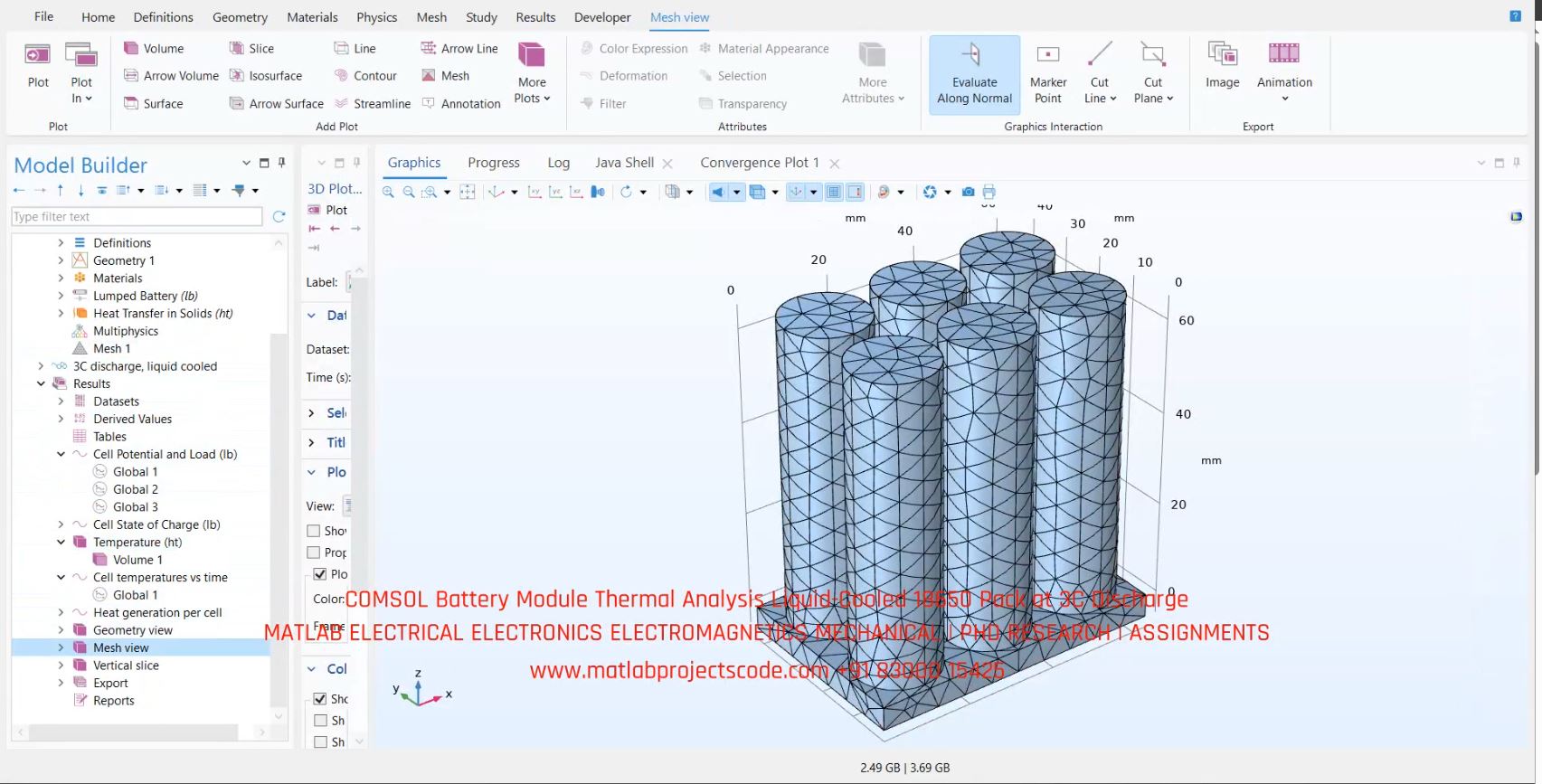
Image availability and extension must be verified on hosting before Google video indexing is assessed.
Research questions and frequently asked questions
Which software is used?
The project is associated with COMSOL Multiphysics; verify the model and solver version with the original video and source files.
Which results should be checked?
Key checks include maximum and mean cell temperature versus time, temperature spread across cells and along the coolant flow path.
Can the video alone validate the results?
No. Model assumptions, boundary conditions and actual output traces must be reviewed before treating any simulation as validated research.
OEM and PhD research enquiries
For research model implementation, simulation verification, paper reproduction and engineering documentation across UK, Australia, Canada, US and global teams, use the contact page. Contents are for representative purposes; actual content may vary.