18650 Lithium-Ion Battery Module Thermal Runaway Propagation in COMSOL
Model possible thermal runaway propagation between neighbouring 18650 lithium-ion cells while examining heat-transfer paths, trigger assumptions and safety-mitigation sensitivities.
Open the MP4 simulation output · Enquire about the model and research support
Research objective
Understand how heat release and thermal coupling could affect the sequence and time scale of neighbouring-cell temperature rises under a stated runaway initiation scenario.
Software, platform and engineering domain
Primary platform: COMSOL Multiphysics. Research domain: Battery Safety and Thermal Engineering. The video title identifies the intended workflow; the video and original model must be inspected before making quantitative claims.
Model architecture and simulation methodology
- Represent individual cell cylinders, busbars/contact regions, spacers and external heat-loss pathways.
- Define a documented onset/heat-release model with calibrated source terms rather than treating an arbitrary temperature threshold as universal.
- Couple cell heat generation to solid conduction, radiation and convection appropriate to the pack configuration.
- Evaluate spacing, barrier conductivity, coolant conditions or vent-direction assumptions without overstating unmodelled gas/fire behaviour.
What the video outputs should demonstrate
- Peak cell temperature and maximum temperature-rise rate
- Time between initiating event and neighbouring-cell thermal response
- Spatial propagation path and integrated heat released per cell
- Sensitivity to barrier materials, gap size and boundary heat loss
Interpreting the simulation results
A simulated rise in neighbour temperature demonstrates a modelled thermal pathway, not validated runaway risk. Propagation conclusions require defensible heat-release inputs and corroborating test data.
- Use chemistry-specific parameter evidence if quantitative predictions are claimed.
- State whether venting, combustion, gas pressure and electrochemistry are excluded.
- Perform time-step and mesh convergence during the rapid exothermic interval.
Suggested research comparisons
- Baseline 1: single-cell initiated heat release
- Baseline 2: unprotected multi-cell module
- Baseline 3: thermally isolated or cooled module
Use the same physical parameters, boundary conditions and plotting window when comparing alternative methods. Numerical improvement cannot be established from the title alone.
Project screenshot and thumbnail
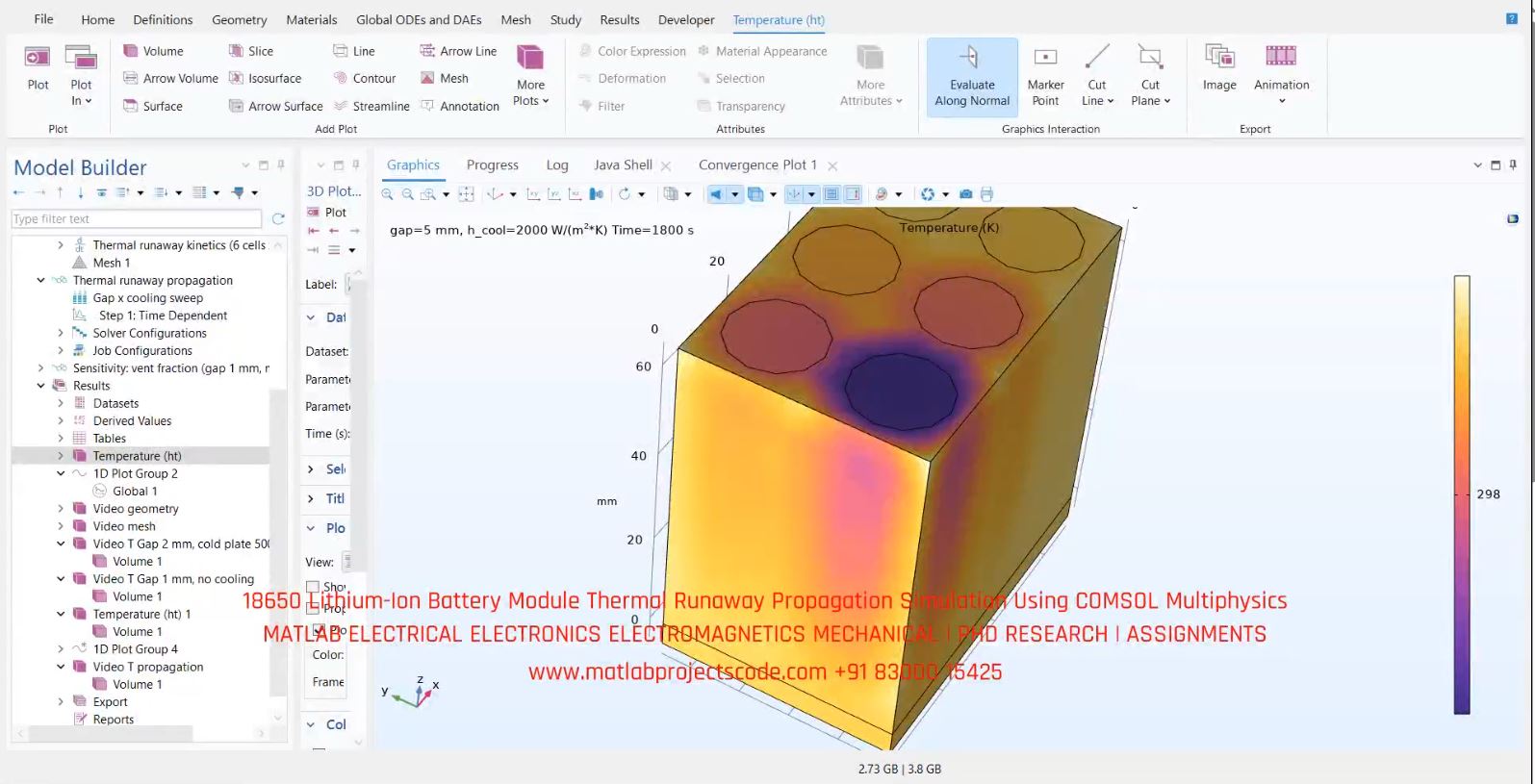
Image availability and extension must be verified on hosting before Google video indexing is assessed.
Research questions and frequently asked questions
Which software is used?
The project is associated with COMSOL Multiphysics; verify the model and solver version with the original video and source files.
Which results should be checked?
Key checks include peak cell temperature and maximum temperature-rise rate, time between initiating event and neighbouring-cell thermal response.
Can the video alone validate the results?
No. Model assumptions, boundary conditions and actual output traces must be reviewed before treating any simulation as validated research.
OEM and PhD research enquiries
For research model implementation, simulation verification, paper reproduction and engineering documentation across UK, Australia, Canada, US and global teams, use the contact page. Contents are for representative purposes; actual content may vary.