SEPIC-Derived Semi-Bridgeless PFC Converter for Battery Charging in MATLAB Simulink & Simscape
Examine a SEPIC-derived semi-bridgeless power-factor-correction front end for battery charging, focusing on shaping the mains input current while regulating a charger output.
Research objective
Examine a SEPIC-derived semi-bridgeless power-factor-correction front end for battery charging, focusing on shaping the mains input current while regulating a charger output.
Software and model scope
Primary environment: MATLAB/Simulink & Simscape. Discipline: Electrical Engineering. The video provides a project demonstration; source models, solver settings and plots should be checked against the actual implementation before reuse.
Simulation / modelling methodology
- Describe each conduction interval and the roles of inductors, coupling capacitor, rectification devices and controlled switches.
- Set up an AC input, high-frequency converter and battery-equivalent load with voltage/current sensing.
- Apply an outer voltage or charging-current loop together with an inner input-current shaping loop and suitable PWM.
- Evaluate startup, line-voltage variation, charging-load variation and realistic switching effects.
Outputs and checks for validation
- Mains voltage and current alignment and input power factor
- Input current harmonic spectrum and THD under declared conditions
- Inductor currents, switch voltage/current stress and converter duty ratio
- Battery charging voltage, current and DC output ripple
How to interpret results
PFC assessment requires both power factor and harmonic distortion; one cannot infer compliance from an aligned waveform alone. Charging regulation must be evaluated at several battery voltages and load conditions.
Verification caveat: Check conduction paths for both mains half-cycles and sign conventions; distinguish ideal and nonideal semiconductors; avoid claiming standards compliance without a stated standard and measured spectrum.
Applications for OEM and PhD research
EV battery chargers, AC–DC conversion, high-power-factor rectifiers, converter efficiency studies and power-electronics coursework.
Project thumbnail
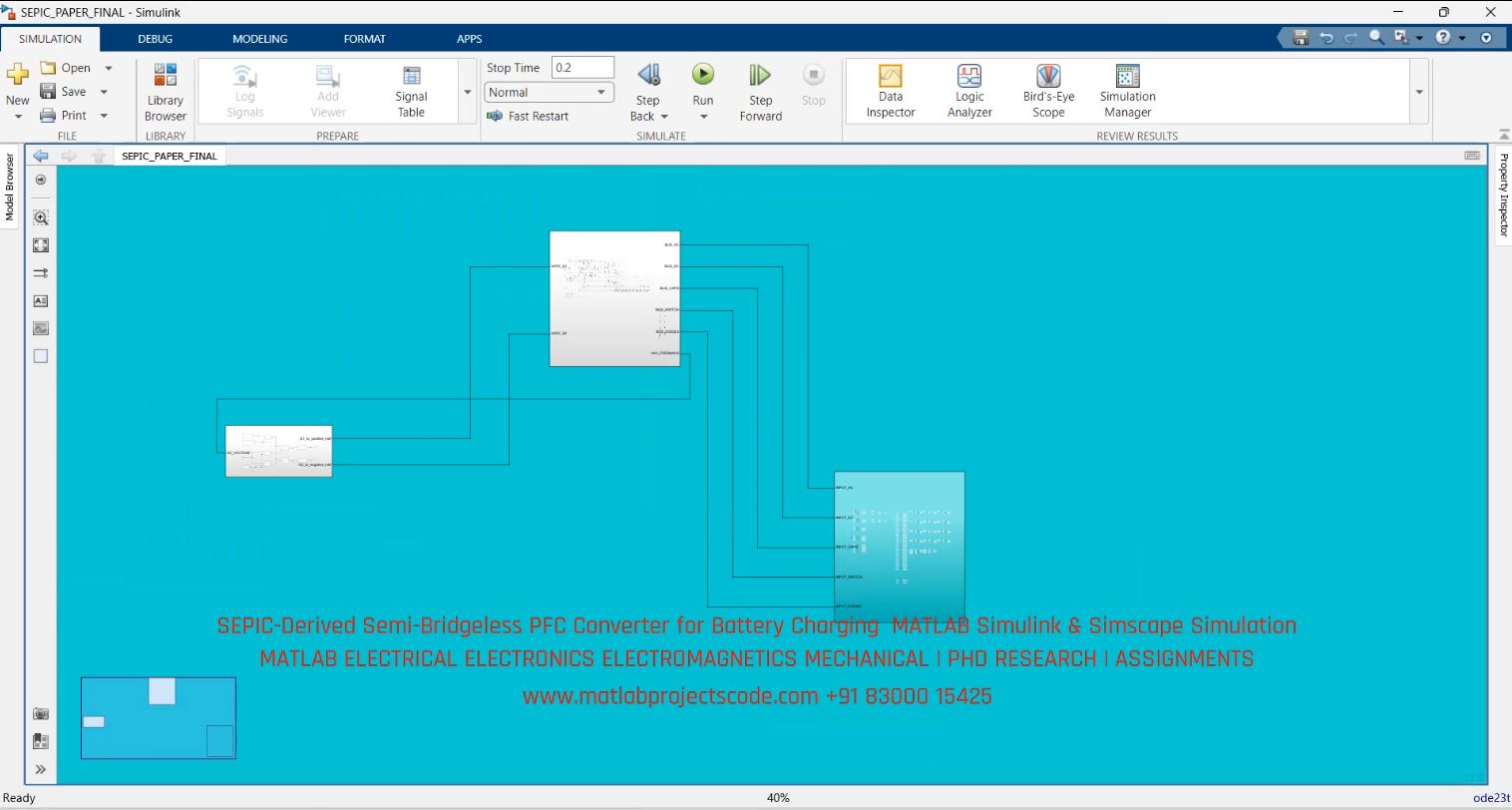
Preview image is matched to the hosted file after media synchronization.
Frequently asked questions
Which software is used for this simulation?
MATLAB/Simulink & Simscape is the primary environment named in this project.
What should be checked before using its results?
Check conduction paths for both mains half-cycles and sign conventions; distinguish ideal and nonideal semiconductors; avoid claiming standards compliance without a stated standard and measured spectrum.
Can this project support a new research comparison?
It can serve as a reference workflow, but any new claim requires a fresh model, documented parameters, independent validation and genuinely measured outputs.
Important notice
contents are for representative purposes, actual content may vary
OEM / PhD Research Enquiry
Request the model scope, software requirements, validation plan and expected deliverables for this topic.
Contact the simulation team WhatsApp +91 83000 15425