28 GHz 1-Bit Reconfigurable Intelligent Surface RIS Design - Ansys HFSS Simulation for 6G Wireless Communication
RIS beam steering, reflection-state modelling and 6G wireless communication antenna verification using electromagnetic simulation outputs. This page is structured for engineering students, OEM teams and PhD research scholars looking for simulation output references, waveform explanation and model implementation support.
PROJECT_THUMBNAIL
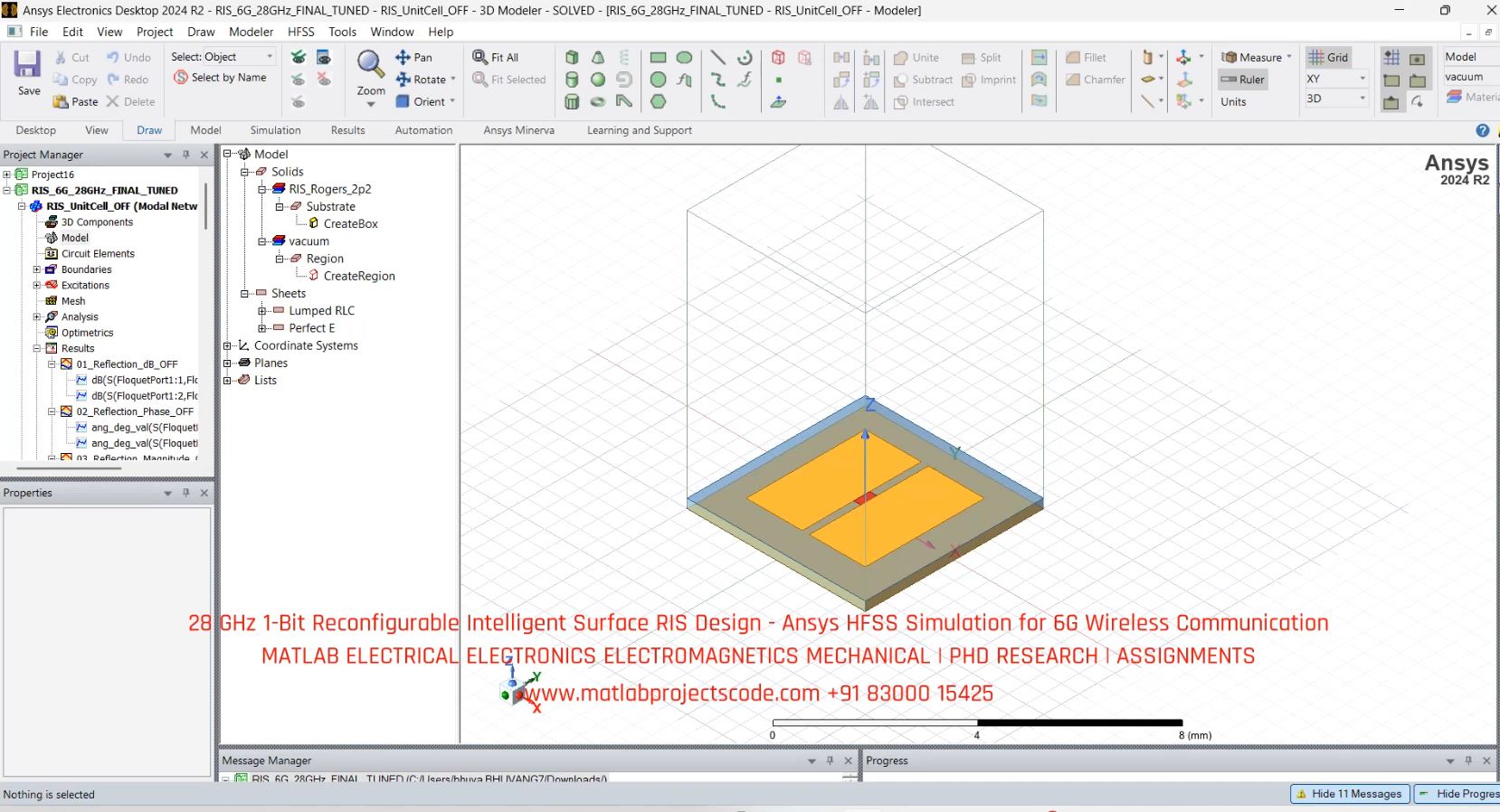
Project Objective
RIS beam steering, reflection-state modelling and 6G wireless communication antenna verification using electromagnetic simulation outputs.
ANSYS HFSS with simulation setup, result windows, model verification, signal logging and output explanation.
Geometry setup, material assignment, boundary conditions, excitation/port definition, frequency sweep, S-parameter extraction and far-field pattern review.
S11/return loss, VSWR, impedance, radiation pattern, gain, efficiency, current distribution and 2D/3D far-field plots.
6G wireless systems, RFID tags, wearable antennas, microwave communication, antenna optimization and OEM RF design validation.
Simulation Model Explanation
The model can be used to study controller behaviour, field response, transient performance, input/output interaction and result quality under representative operating conditions. The project page supports model verification, research report preparation, waveform interpretation and implementation discussion for Electromagnetics workflows.
Result Interpretation
Result interpretation focuses on response accuracy, stable operation, improved regulation, bandwidth/resonance behaviour, reduced error or useful comparison between reference command and measured simulation output. The displayed video and thumbnail provide a quick visual check before contacting for the full model, source files, explanation or documentation.
Need this simulation model?
Share the project title, software version, required outputs and deadline. We support OEM-style validation, PhD research implementation, report writing and waveform explanation.
Open Contact Page →