
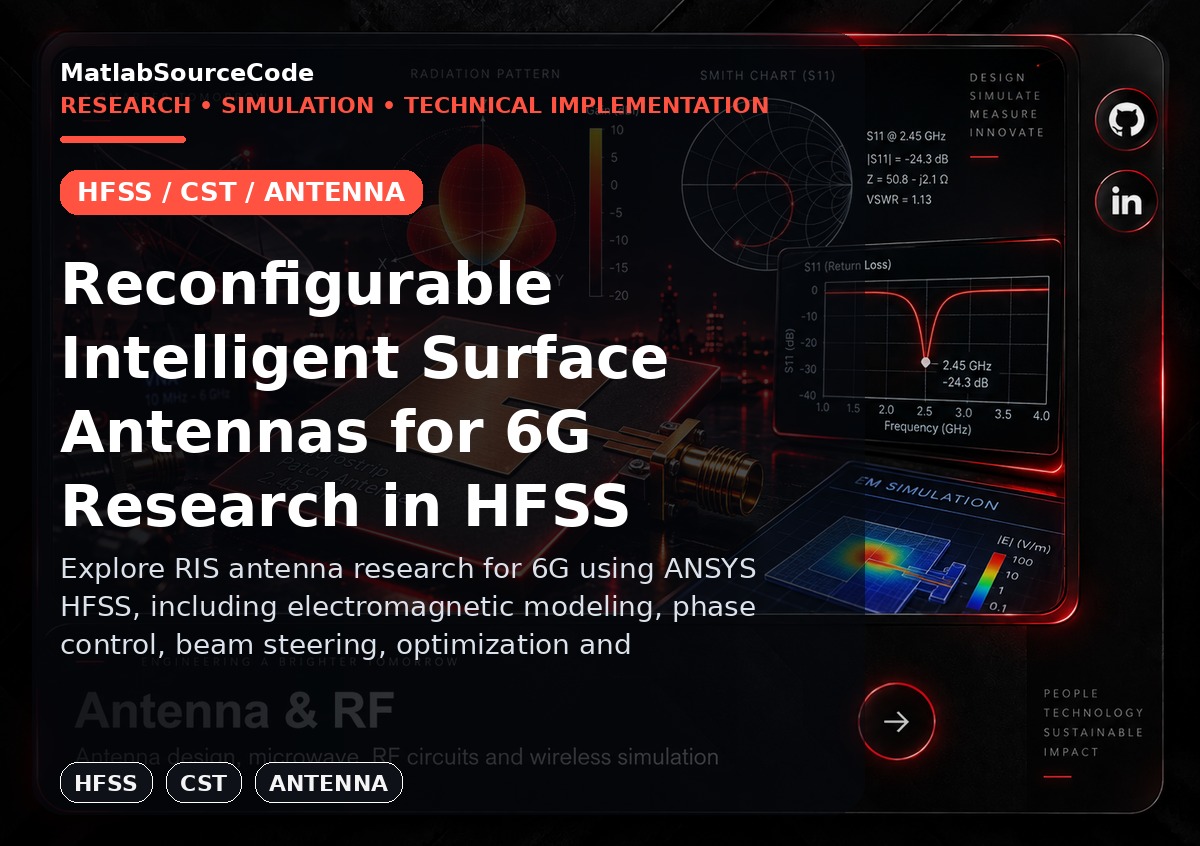
28 GHz 1-Bit RIS Design in HFSS for 6G: Unit Cell to Array
HFSS / 6G RIS

The design problem is to improve a biconical antenna around the 2.45 GHz ISM band using an FSS without creating excessive mismatch, narrow bandwidth, unwanted lobes or impractical spacing.
A meaningful FSS study needs a validated antenna baseline. Tune feed and radiator geometry first so any later change can be attributed to the frequency selective surface.
Unit-cell transmission and reflection response provide a physical basis for selecting periodicity, element shape and operating region. This prevents blind antenna-plus-FSS optimization.
The distance between the radiator and FSS can shift resonance, alter front-to-back ratio and change realized gain. Sweep spacing rather than fixing it from a single trial.
Matching, gain, radiation efficiency, beam shape and bandwidth should be reported together. A useful enhancement should survive across the intended 2.45 GHz application band.
Low-profile surfaces, dual-band operation, angular stability and fabrication-tolerance analysis provide clear extensions for postgraduate or PhD research.
Share your project title, abstract or base paper, preferred software version and required plots. The existing video project can be reviewed as a baseline and extended around a measurable research objective.
HFSS / Printed Antennas
HFSS / Patch Antennas
HFSS / Printed Antennas
HFSS / Patch Antennas


