
HFSS / Printed Antennas
DFBGS 5.9 GHz Printed Antenna in HFSS: Novelty and Validation
HFSS / Printed Antennas
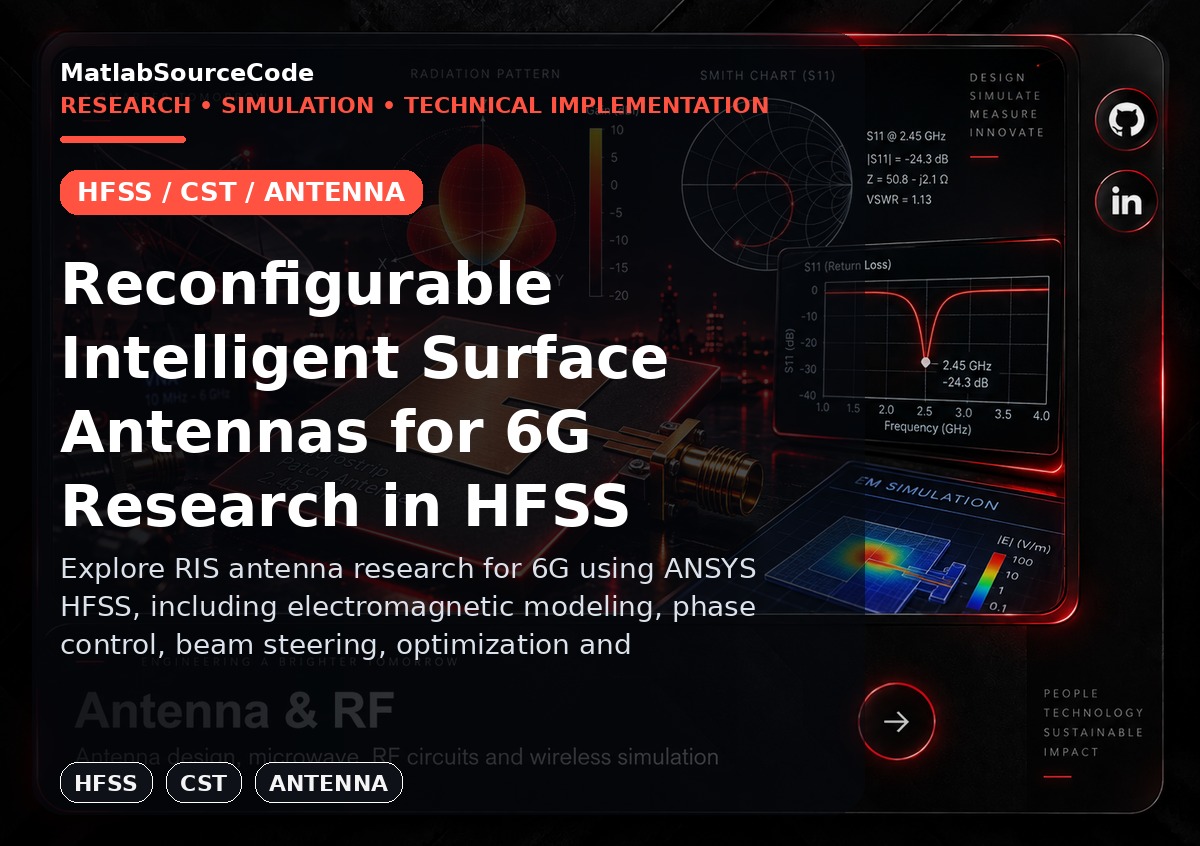
The central problem is to realize two practical RIS states near 28 GHz that provide a useful binary reflection-phase contrast while keeping reflection loss, bandwidth and angular sensitivity under control.
A 1-bit RIS uses two discrete electromagnetic states rather than a continuously tunable phase. This simplifies control but makes phase error, reflection loss and quantization effects central research questions.
Periodic boundaries with Floquet excitation are commonly used to study one RIS cell. Geometry, substrate, conductor loss, switch representation and port de-embedding must be kept consistent across both binary states.
A nominal phase separation is useful only when reflection magnitude remains acceptable and the response is stable over frequency, polarization and incidence angle. Surface-current plots help explain why the two states differ.
Finite-array steering requires a coding matrix that maps desired aperture phase to the available binary states. Array size, element spacing, phase quantization and edge effects influence realized gain and sidelobes.
Useful research directions include wide-angle cells, 2-bit control, switch parasitics, bias-network integration and EM-to-link co-simulation for realistic 6G coverage studies.
Share your project title, abstract or base paper, preferred software version and required plots. The existing video project can be reviewed as a baseline and extended around a measurable research objective.
HFSS / Printed Antennas

HFSS / CST / FSS
HFSS / Patch Antennas
HFSS / Printed Antennas
HFSS / Patch Antennas


