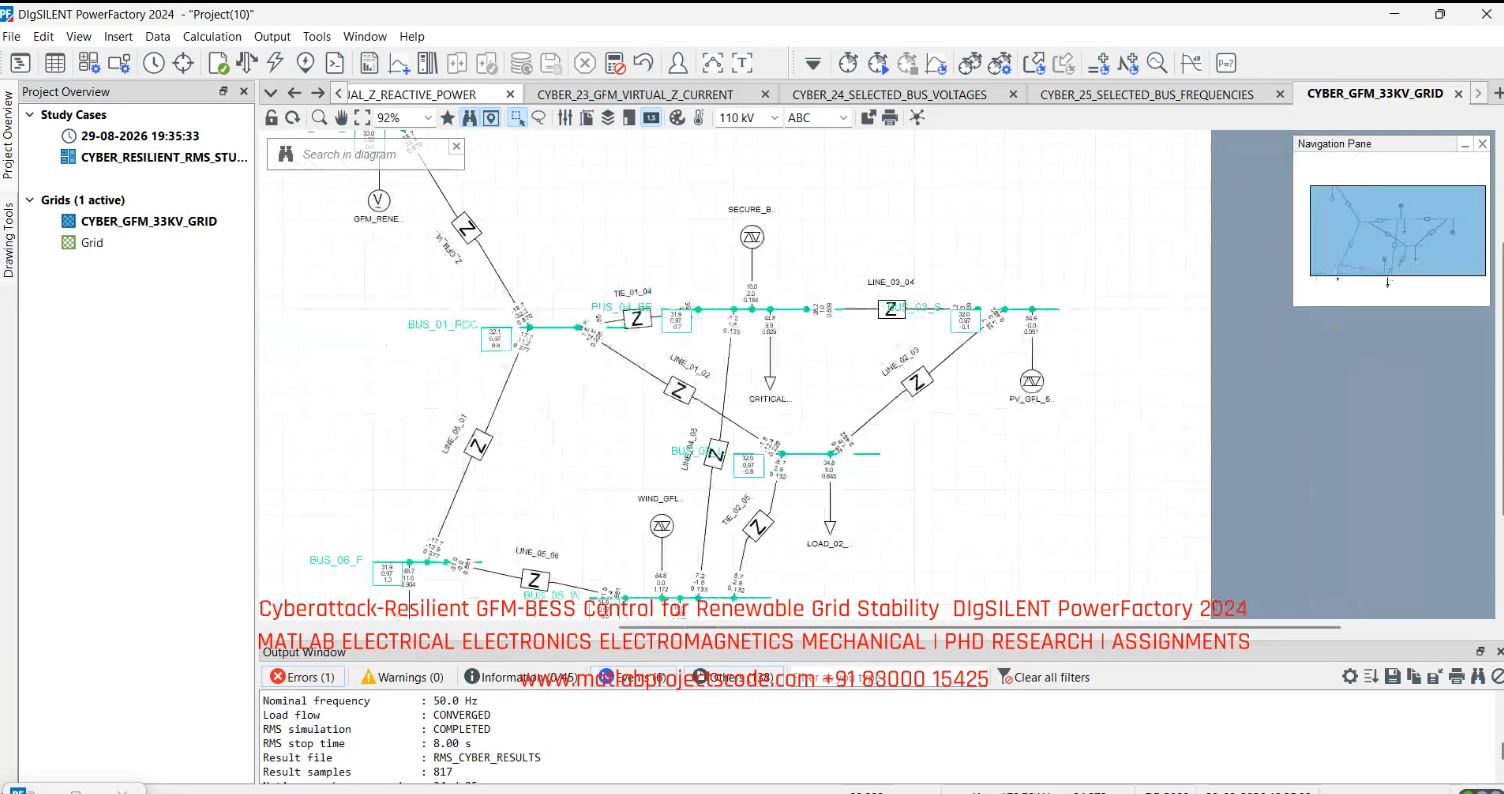
Cyberattack-Resilient GFM-BESS Control for Renewable Grid Stability DIgSILENT PowerFactory 2024
Digsilent powerfactory dynamic simulation, rms stability assessment, event studies and power-system validation. This page is structured for engineering students, OEM teams and PhD research scholars looking for simulation output references, waveform explanation and model implementation support.
Cyberattack-Resilient GFM-BESS Control for Renewable Grid Stability DIgSILENT PowerFactory 2024 Simulation Objective and Model Scope
Cyberattack-Resilient GFM-BESS Control for Renewable Grid Stability DIgSILENT PowerFactory 2024 is a Renewable Energy project built around cyber-resilient grid-forming BESS behaviour, renewable-grid stability recovery and disturbance response under abnormal control or switching events. The page explains what the model is expected to demonstrate, how the DIgSILENT PowerFactory 2024 workflow is arranged and which output signals are most useful for validating the result.
The topic is suitable for PhD research preparation, engineering assignment reference, OEM model comparison and custom simulation development. Important title terms such as Cyberattack, Resilient, GFM, BESS, Control, Renewable, Grid, Stability are treated as the actual modelling focus, not just keywords, so the explanation remains connected to the project output shown on this page.
The project uses a structured simulation setup with the selected software platform, required parameters, controller blocks, measurement points and output scopes aligned to the project title.
The model represents renewable source, grid-forming BESS, weak-grid interface, protection or event blocks, frequency/voltage measurement channels and post-event result scopes. The block arrangement is intended to show the physical system, controller interaction and recorded response path clearly.
baseline operation is compared with attack or disturbance cases to verify BESS support, frequency recovery, voltage damping and controller robustness
PCC voltage, system frequency, RoCoF, BESS active/reactive power, DC/control response and recovery time after the disturbance
renewable grid stability studies, low-inertia grid validation, GFM-BESS controller benchmarking, utility planning and cyber-resilient microgrid research
check whether the GFM-BESS restores voltage and frequency faster than the disturbed case while limiting oscillations and avoiding unstable power swings
Project Scope and Study Focus
This Electromagnetics page focuses on Cyberattack-Resilient GFM-BESS Control for Renewable Grid Stability DIgSILENT PowerFactory 2024 using DIgSILENT PowerFactory 2024. The explanation highlights the model objective, implementation route, expected outputs and result interpretation so visitors can quickly decide whether this project matches their academic, research or OEM requirement.
Core study terms for this page include Cyberattack, Resilient, GFM, BESS, Control, Renewable, Grid, Stability. These terms define the project components, controller or algorithm direction, validation plots and practical use case. Related pages below help compare this topic with similar simulation outputs, software workflows and domain-specific research paths.
Explore Related Research Paths
Project archive · Renewable Energy domain · DIgSILENT PowerFactory 2024 support · PhD research support · OEM licensing · Research methodology · Case studies · Contact support
Related Project Pages
FAQ
What does this project demonstrate?
Cyberattack-Resilient GFM-BESS Control for Renewable Grid Stability DIgSILENT PowerFactory 2024 demonstrates grid stability, low-inertia operation, converter-dominated power system behaviour and dynamic disturbance assessment using DIgSILENT PowerFactory 2024 and provides output-video evidence, thumbnail preview and topic-specific modelling notes.
Can this be customized for PhD or OEM requirements?
Yes. Parameters, controller structure, disturbance cases, output plots and documentation format can be adjusted for university, journal, assignment or OEM validation needs.
Which related outputs should be checked?
Review bus voltage, system frequency, RoCoF, active/reactive power, BESS response, rotor angle or converter control traces and compare them with the related internal pages listed above to select the closest model variant.
Request This Project Model
Send the project title, required software version, deadline, expected waveforms and any base-model screenshots. Contents are for representative purposes, actual content may vary.